Parenting
My teenager won't do anything: what can I do when I've tried everything?
Pierre-Alexis Voisin
•
May 4, 2026
•
9
reading time

Are you the parent of a teenager who doesn't want to do anything? It's not laziness, nor is it a lack of discipline. After speaking with hundreds of families, I can tell you this: the problem is almost never the child. Here's what's really going on—and what works when everything else has failed.
If you’re reading this, there’s a good chance you’re exhausted. Exhausted from daily arguments. Exhausted from repeating the same things over and over. Exhausted from feeling like you’re the bad guy, the enforcer, the designated killjoy.
Your child is between 10 and 15 years old, is in middle school, and nothing seems to be working:
And once he's gone? Back to square one.
Meanwhile, your teenager is doing just fine:
So one question keeps coming up:
“Why is he able to focus so intently on a game, but not even for 10 minutes on his schoolwork?”
It’s important to make this clear:
The real problem is that school and homework speak a language that is no longer his own.
Children of this generation are still being asked to:
Meanwhile, the rest of their world works the opposite way: immediate interaction, constant feedback, visible progress, a sense of mastery, and intrinsic motivation.
The gap is enormous. And as long as we expect him to bridge that gap through sheer willpower alone, we’re wasting our time.
We also explore this topic from the perspective of motivation in "How to Motivate a Middle School Student to Do Their Homework."
It either creates resistance or an artificial sense of motivation that fades as quickly as the reward.
The result: the child doesn't see the point, the parent bears the entire burden, and the family atmosphere deteriorates. To better understand the different methods and their limitations, check out our comparison of study aids for middle school.
It was precisely this realization that led to the creation of Baobab.
Baobab isn't a game. But Baobab uses the conventions of games. The distinction is crucial.
While traditional methods try to force an outdated format, Baobab starts from a simple observation: if teens can focus on *Brawl Stars* for two hours, it meansthere are certain approaches that work for them. We just need to apply those approaches to learning.
Baobab was designed for those kids. The ones who don't want to do anything. The ones for whom homework has become a battlefield.
And most importantly: he's eager to get started.
Baobab is the app that turns screen time into valuable time. Download it for free.


That’s THE phrase parents say most often.
Kids come home from school, pull out their phones, take pictures of their homework, and start their quizzes— without being asked.
For many parents, it comes as a shock. Because all of a sudden: the arguments stop, the mental load eases up, the child becomes more independent, and the family atmosphere calms down.
And if this change seems a bit suspicious to you (“another screen?”), we’ve addressed it in detail in our article on good vs. bad screen time.
If you've tried everything, negotiated everything, explained everything, threatened everything, and given up on everything… then the problem isn't that your child "won't do anything."
The problem is that the homework isn't written in a way he can understand.
Baobab doesn't promise miracles. But Baobab changes the game. And sometimes, that's all it takes to get things moving.
If your teenager refuses to do their homework despite your best efforts, check out Baobab : the method that speaks their language, starting from their actual coursework, and allowing them to work independently.


A father of two and a trained engineer, Pierre-Alexis left the finance industry in 2020 to develop impact-driven projects, including Baobab Labs, an app that helps middle school students study more effectively.
Because games offer what homework doesn't: immediate feedback, visible progress, and a sense of mastery. The problem isn't your child's ability to concentrate—it's the format they're being given.
Avoid direct confrontation. Punishment creates conflict, while rewards provide only short-lived motivation. The most effective approach is to change the homework experience: make it active, self-directed, and provide concrete feedback on what has been learned.
The breakdown usually occurs between 6th and 8th grade—a time when the workload skyrockets, the pressure to get good grades increases, and the allure of screens grows stronger. Many teens “drop out” at this point.
They work… when the teacher is there. The problem is that they don’t foster independence: as soon as the adult is no longer present, the teenager slips back into their old habits.
By offering a format that fits their learning style: interactive, self-paced, with visible progress. And by building on their current skill level, so that their efforts pay off right away (better control, for example).
Baobab is designed for middle school students, but as the application adapts to each child's lesson, it also works through to high school.
The AI analyzes the lessons to suggest revisions tailored to each level.
With a single subscription, you can add up to 3 children.
Everyone gets their own account and can use Baobab on their phone, with revisions tailored to their level and lessons.
Yes! Baobab's AI analyzes your child's lesson to generate customized revision sheets and quizzes.
The goal: to help them learn more effectively, without wasting time on unnecessary content.
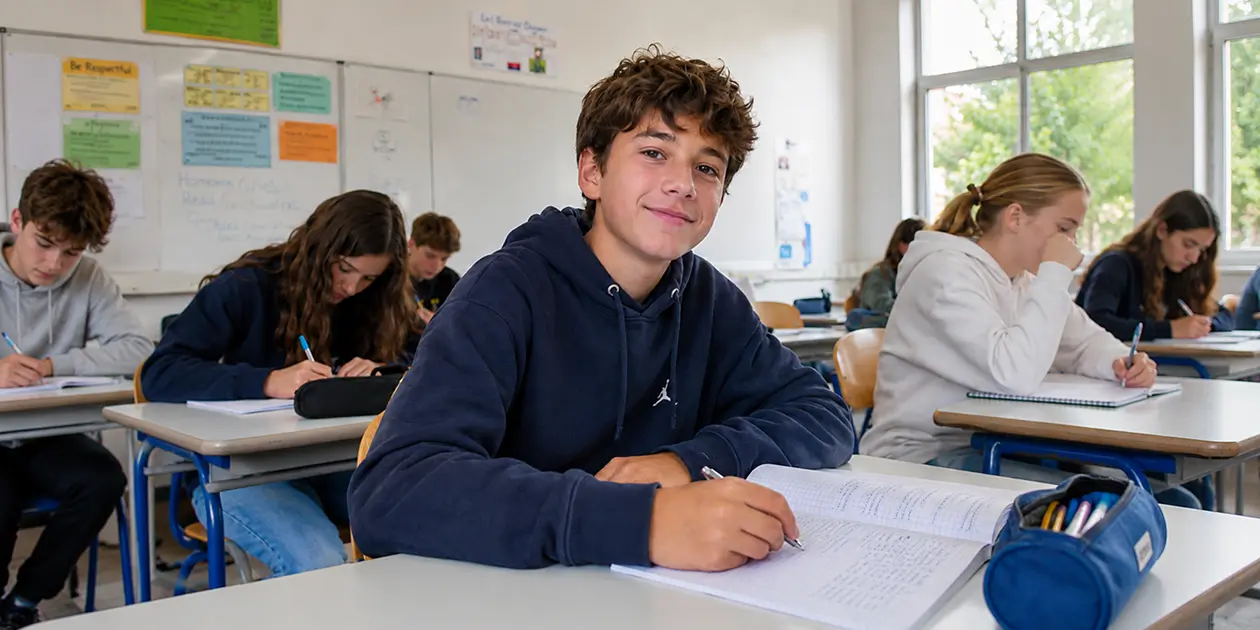
Relire ne suffit pas : la science est claire. Découvrez la méthode en 3 étapes pour apprendre une leçon au collège, et le rôle exact du parent le soir.
Learn more
Feeling nervous about the start of the school year? How to tell the difference between normal jitters and chronic anxiety—and 5 practical steps to help your child during the first week.
Learn more
Starting 6th Grade: What Really Changes, Common Fears, and Habits to Establish Starting in September for a Smooth Transition—for Your Child and for You.
Learn more
 Sitting alone
 Instant interaction