Updated in May 2026.

Choosing the best study app for a middle schooler has become a headache for many families. Between Kartable, Acadomia, Baobab, and DIY methods, there are plenty of options—and not all of them offer the same benefits. Here’s a clear comparison to help you choose based on your actual needs.

In short

  • Baobab starts with the child's current level and helps prepare them for tests.
  • Kartable offers standard educational content aligned with official curricula.
  • Acadomia offers personalized tutoring with a teacher.
  • Traditional methods (peer review, study cards, parents) remain free but unreliable.

The best choice depends on the problem at hand: filling a gap? studying effectively for a test? helping a child who is struggling?

Why make that comparison?

Helping children with their homework has become a major concern for many parents, especially during middle school. Lack of motivation, test anxiety, time spent reviewing material without knowing if it’s really been mastered… Solutions do exist, but not all of them are equally effective depending on the goal.

In this article, we compare four common methods for helping children learn their lessons more effectively, along with their advantages, limitations, and the types of students they are best suited for.
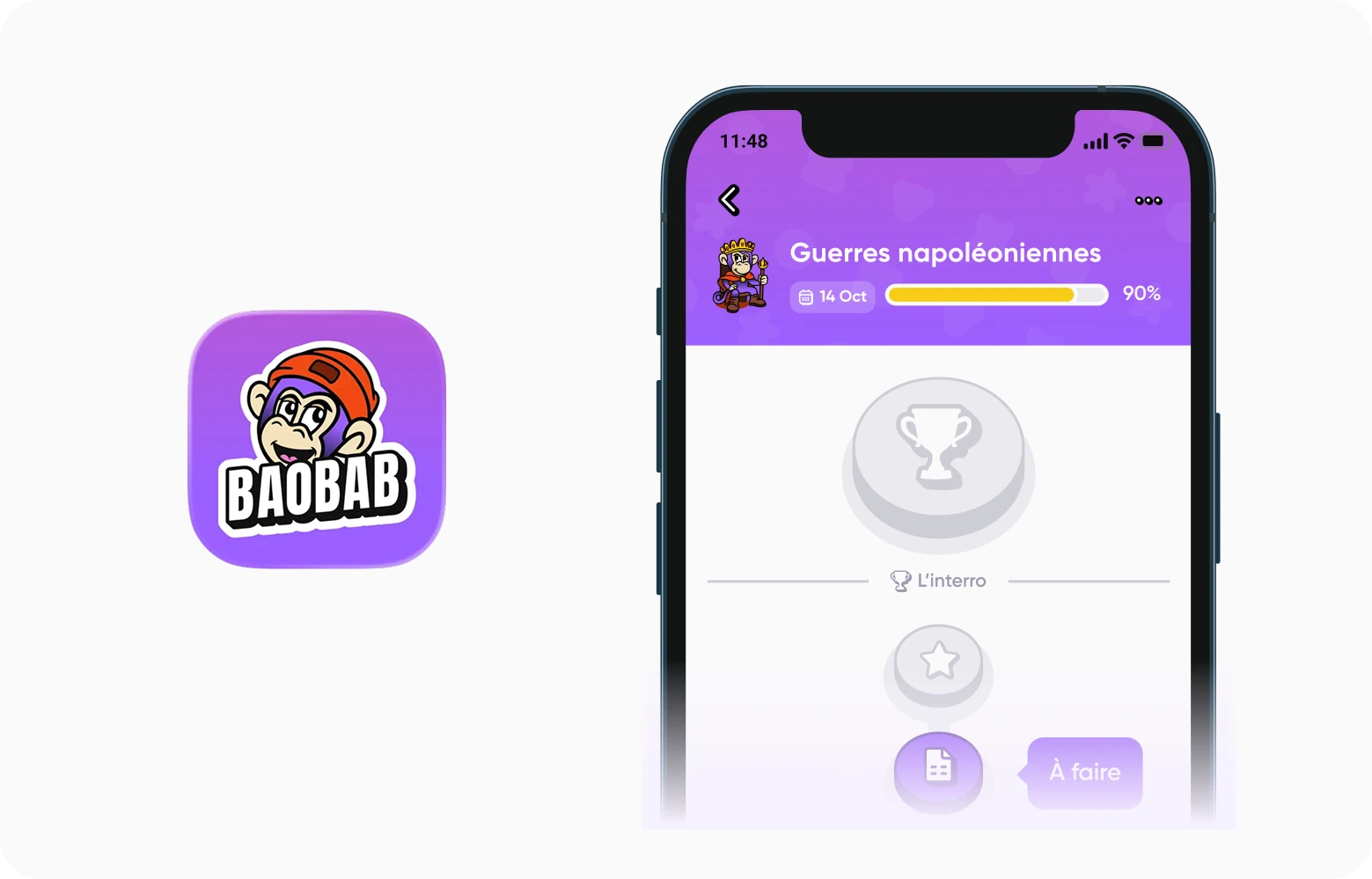
1. Baobab — Find out exactly what will be on the test

Baobab is an app designed to address a very specific question: “Does my child really know their lesson?”

Why Baobab works particularly well

  • 100% tailored to the child's individual needs. The child learns a curriculum designed specifically for them by their teacher. No generic content, no standard curriculum.
  • Highly targeted preparation. What the child works on in Baobab = what might appear on the test.
  • Active learning (not just reading through the material). The child is asked questions, tests themselves, and reinforces their knowledge.
  • It has a strong reassuring effect. Uncertainty disappears: the child knows where they stand. This is the key to alleviatingschool anxiety.
  • Independence + motivation. The child works on their own, without any parent-child tension.

Price

€66 per year, or less than €6 per month for the entire school year.

Ideal for

  • Children who feel anxious before tests
  • Middle school students who work but have doubts
  • Parents who want to save time without losing track of their children

Limitations

  • Designed for reviewing lessons: if your child needs to learn a concept they didn't understand in class, additional in-person support is still preferable.
  • This format assumes that the child will be using a smartphone.

2. Kartable — High-quality, but standardized content

Kartable is a well-known platform that has been a fixture in the online tutoring industry for several years.

Key strengths

  • High-quality, well-structured educational content
  • In accordance with the official curriculum of the French Ministry of Education
  • Broad coverage of subjects

Limitations

  • Standard curriculum. The child does not learn a specific lesson, but rather a standard lesson plan.
  • There may be a discrepancy between this and what the teacher actually expects.
  • It may be reassuring… but it doesn’t guarantee that you’ll be truly prepared for today’s specific test.

Price

Approximately €70 per year (depending on the plan, based on 2025 public data).

Ideal for

  • Review a subject comprehensively
  • Exploring a concept you don't understand
  • Complete schoolwork

Less suitable for preparing a specific quiz on a particular course.
3. Acadomia — Highly personalized, but restrictive

Acadomia offers tutoring with a teacher, either in-home or online. It is one of the leading providers in France in this sector.

Key strengths

  • Content 100% tailored to the child's needs
  • Regular personal and educational support
  • Tailored to specific challenges (learning gaps, learning disabilities, dropping out)

Limitations

  • A lot of logistics. Finding a teacher, coordinating schedules, managing absences…
  • Dependence on an adult. Progress often fades when the teacher is no longer there—a point we discuss in My Teen Won’t Do Anything.
  • High cost.
  • Less accessible outside major cities.

Price

About €25 to €30 per hour (public data from Acadomia 2025), which amounts to several hundred euros per year for regular tutoring.
Ideal for

  • Significant academic difficulties
  • Specific, one-time needs
  • Families willing to invest a significant amount of money

4. "Traditional" methods (review, flashcards, parents)

The most common method… and the least reliable.

Key strengths

  • Free
  • Available immediately
  • Fosters a parent-child bond through schoolwork

Limitations

  • The illusion of mastery (“I’ve read it again, so I know”)
  • Very anxiety-inducing for some children
  • Places a heavy burden on the parent (cognitive load)
  • Not very effective without a structured self-assessment

Ideal for

  • Very easy to memorize
  • Children who are already very comfortable and independent

Insufficient to ensure a secure, high-stakes test.

How do you choose the best method for your child?

The right method depends on the problem you're trying to solve:

  • If your child is unsure about what they know before tests → Baobab (actual lessons + self-assessment)
  • If your child needs to review a concept they didn't quite grasp in class → Kartable or a one-time private lesson
  • If your child is falling behind or struggling significantly → Acadomia or regular tutoring
  • If your child is already independent and doing well → traditional methods may be sufficient

It is also possible to combine several approaches: Baobab for daily review, and occasional human support for complex concepts.

Baobab is the app that turns screen time into valuable time. Download it for free.

In summary

  • Baobab is the most well-rounded solution for preparing for daily tests: tailored to the actual class, reassuring, accessible, and self-paced.
  • Kartable is a useful supplement for exploring a concept in greater depth.
  • Acadomia is effective but expensive and time-consuming, and is generally reserved for serious academic difficulties.
  • Traditional methods remain effective for children who are already independent, but they quickly reveal their limitations.

If your goal is for your child to approach their exams with confidence, well-prepared, and calm, the most effective approach is one that draws directly from their actual coursework.

Want to try Baobab?

Discover Baobab and give your middle schooler a self-paced review method based on their actual coursework.

Pierre-Alexis Voisin

Co-founder, Baobab Labs

A father of two and a trained engineer, Pierre-Alexis left the finance industry in 2020 to develop impact-driven projects, including Baobab Labs, an app that helps middle school students study more effectively.

Still need help?

What is the best study app for a middle school student in 2026?

There is no single "best app" in absolute terms: it all depends on your needs. For targeted test preparation, Baobab is the most effective solution because it is based on the actual curriculum. For a comprehensive overview of a subject, Kartable offers solid educational content.

Kartable or Baobab: Which One Should You Choose?

Kartable offers standard educational content that helps students understand key concepts. Baobab focuses on your child’s teacher’s specific lesson plan to help them prepare for a particular test. The two can complement each other.

Does Baobab replace private lessons?

For regular review and test preparation, yes. But when it comes to filling in real gaps in knowledge or understanding a complex concept, in-person support is still the best option as a supplement.

How much do online study guides for middle school cost?

Apps like Baobab (~€66/year) or Kartable (~€70/year) cost around €5 to €7 per month. Personal tutoring (Acadomia, private tutors) costs €25 to €30 per hour, which amounts to several hundred euros per year.

Starting in which grade is a study app useful?

The benefits become apparent as early as 6th grade, but it is in 7th and 8th grade that the sheer volume of material to memorize and the pressure of tests make these tools most useful.

What grades is Baobab for?

Baobab is designed for middle school students, but as the application adapts to each child's lesson, it also works through to high school.

The AI analyzes the lessons to suggest revisions tailored to each level.

What if I have several children?

With a single subscription, you can add up to 3 children.

Everyone gets their own account and can use Baobab on their phone, with revisions tailored to their level and lessons.

Do you use AI?

Yes! Baobab's AI analyzes your child's lesson to generate customized revision sheets and quizzes.

The goal: to help them learn more effectively, without wasting time on unnecessary content.
See also

Screens
Good vs. Bad Screen Time: What Parents Need to Know

Not all screen time is created equal. The real question isn’t “how much time?” but “what kind of screen time?” A guide to distinguishing between good and bad screen time.

Learn more
Motivation
How to Motivate a Middle Schooler to Do Their Homework (Without Yelling or Arguments)

If your child drags their feet, sighs, or refuses to sit down at their desk… it’s neither a lack of willpower nor a tantrum. It’s a matter of experience. Here’s a closer look and some solutions.

Learn more
Parenting
My teenager won't do anything: what can I do when I've tried everything?

Have you tried everything and nothing seems to work with your teenager? It’s not laziness or a lack of discipline. Here’s what’s really going on—and what actually works.

Learn more