Motivation
How to Motivate a Middle Schooler to Do Their Homework (Without Yelling or Arguments)
Pierre-Alexis Voisin
•
May 4, 2026
•
7
reading time

For many families, motivating a middle schooler to do their homework has become the most exhausting daily struggle. But what if the problem isn’t laziness or a lack of willpower? Here’s what lies behind this resistance—and three practical strategies to turn homework time into a serious yet calm routine.
If you're the parent of a child between the ages of 10 and 15, chances are this scenario sounds familiar:
It's time for homework. Your child is dragging their feet, putting it off, sighing… and just the thought of sitting down at their desk already seems like a struggle.
What if the problem wasn't laziness or a lack of willpower?

Our children are growing up in a world where everything is more engaging than their lessons: screens, games, notifications, short videos…
Given that, asking them to sit alone and read a lecture is like offering them the least appealing option possible.
It's not a matter of unwillingness. It's simply a lost cause when it comes to getting people's attention.
We explore this topic from the perspective of screen time in Good vs. Bad Screen Time: What Parents Need to Know.
Let's be honest: learning a lesson by reading it over and over again, all by yourself, without any interaction, isn't much fun.
Above all, children know full well what lies ahead: a quiz in class, or a parent asking questions, and the fear of not knowing the answers.
In other words, the effort is clear, but the reward… is very unclear. The result: the whole experience feels like something best avoided.
For a long time, children were expected to sit down at their desks on their own, read their lessons quietly, and learn “on their own.”
But this method no longer fits: neither their environment, nor their approach to motivation, nor the way they learn effectively.
It's not that they don't want to learn. It's just that the format we're offering them doesn't engage them.
A child's motivation rests on two simple pillars:
When these two elements come together, the relationship to work changes completely.
That is exactly the idea on which Baobab was built.

Lever 1
Change the format, not the intent

Lever 2
Make progress visible

Lever 3
Giving meaning to the immediate effort
Instead of trying to force motivation, changethe homeworkexperience. A child who is asked questions rather than passively rereading, who makes progress in small, visible steps, and who receives immediate feedback on what they’ve accomplished… is engaging in an approach that aligns with how their brain works today.
Teens need to see that they're making progress. That's one of the key lessons from video games: the progress bar, leveling up, earning stars. None of that is present in a traditional lesson.
To gain this clarity on your assignments, ask this simple question: “In this lesson, what do you already know how to do, and what do you still need to learn?” This simple reframing turns a vague task into a measurable journey.
The child needs to be able to think, “If I make this effort now, I’ll get something out of it right away.” Not in three months. Not at the end of the year.
The most powerful "reward" isn't a material one (which wears off quickly, as we explain in My Teen Won’t Do Anything): it’s the feeling of competence. Knowing that you’ve mastered your lesson is the most immediate reward there is.
With Baobab, we’ve taken a different approach to the traditional homework experience.
Children are no longer on their own when it comes to their lessons. They interact, make progress, and unlock rewards in a world that feels familiar to them—one that aligns with the conventions they already know and enjoy.
Every effort is recognized. Every lesson learned is acknowledged. The child can clearly see that they are making progress, which naturally fuels their motivation.
Very quickly, the child realizes something essential:
“When I work with Baobab, I perform better.”
And when a child knows they're going to succeed, they no longer need to be pushed.
Want to compare Baobab with other options like Kartable or Acadomia? Our detailed comparison of middle school study methods breaks it all down.
Baobab is the app that turns screen time into valuable time. Download it for free.


For parents, the effect is often immediate: fewer endless negotiations, less stress at the end of the day, and less need to act as the "homework police."
Learning becomes more independent for the child and more stress-free for the whole family.
By making homework more fun, more rewarding, and more effective, we can turn it into a much more bearable experience—for both children and parents.
Discover Baobab : the solution that turns lesson review into a motivating, self-directed experience based on your child’s actual coursework.


A father of two and a trained engineer, Pierre-Alexis left the finance industry in 2020 to develop impact-driven projects, including Baobab Labs, an app that helps middle school students study more effectively.
By changing the format of homework rather than trying to force motivation. An interactive format (self-assessments, immediate feedback, visible progress) aligns with how teens learn today and fosters natural motivation.
Because they create external motivation that wears off quickly. Lasting motivation comes from within: it stems from a sense of competence —knowing that you’ve accomplished something.
This is very common. Middle school brings a host of challenges: an increase in the number of subjects, rising academic expectations, and more screen time. It doesn’t have to be this way, but it requires a change in approach rather than simply pushing harder.
After a snack and a short break (15–30 minutes) after getting home from school. Energy levels are still high, but the pressure of school has subsided. However, avoid doing homework after 7 p.m., when fatigue reduces productivity.
45 minutes to 1 hour and 30 minutes, depending on the grade level (6th → 9th grade). But quality matters more than duration: 30 minutes of self-assessment exercises are often more effective than 1 hour and 30 minutes of passive review.
Baobab is designed for middle school students, but as the application adapts to each child's lesson, it also works through to high school.
The AI analyzes the lessons to suggest revisions tailored to each level.
With a single subscription, you can add up to 3 children.
Everyone gets their own account and can use Baobab on their phone, with revisions tailored to their level and lessons.
Yes! Baobab's AI analyzes your child's lesson to generate customized revision sheets and quizzes.
The goal: to help them learn more effectively, without wasting time on unnecessary content.
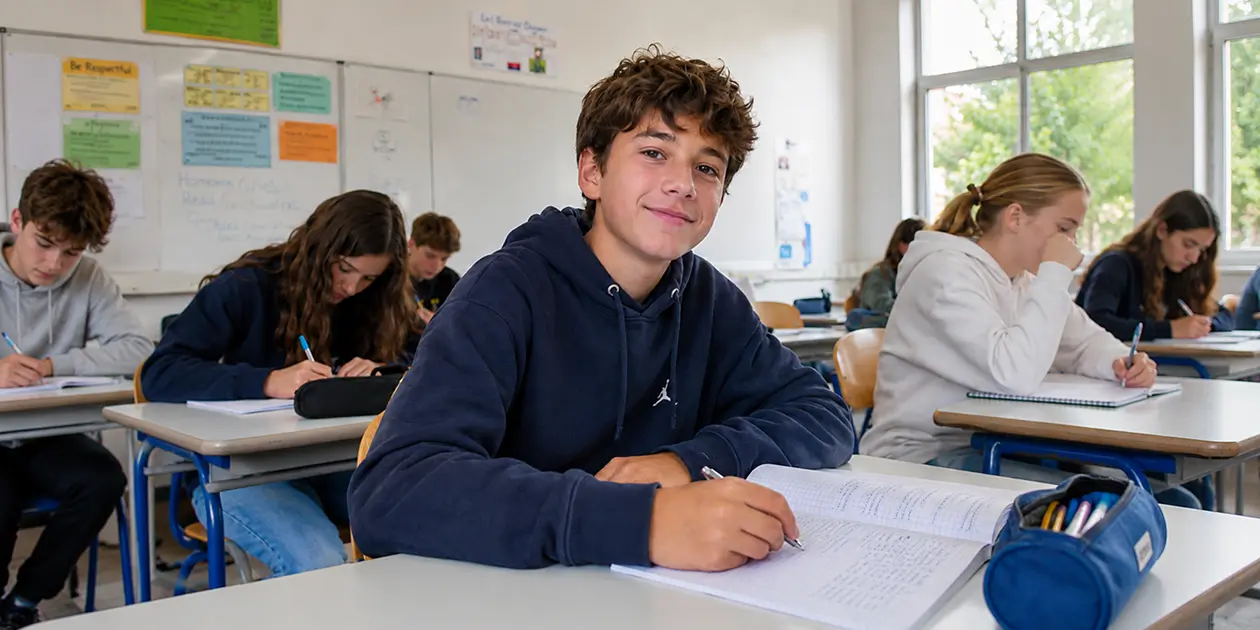
Relire ne suffit pas : la science est claire. Découvrez la méthode en 3 étapes pour apprendre une leçon au collège, et le rôle exact du parent le soir.
Learn more
Feeling nervous about the start of the school year? How to tell the difference between normal jitters and chronic anxiety—and 5 practical steps to help your child during the first week.
Learn more
Starting 6th Grade: What Really Changes, Common Fears, and Habits to Establish Starting in September for a Smooth Transition—for Your Child and for You.
Learn more